The Fine-Tuning Handbook: Free
A free 61-page guide to fine-tuning language models: when to fine-tune, which method to use, how to prepare training data, and how to evaluate the result. Download it with the code FERNFLYBLOG.
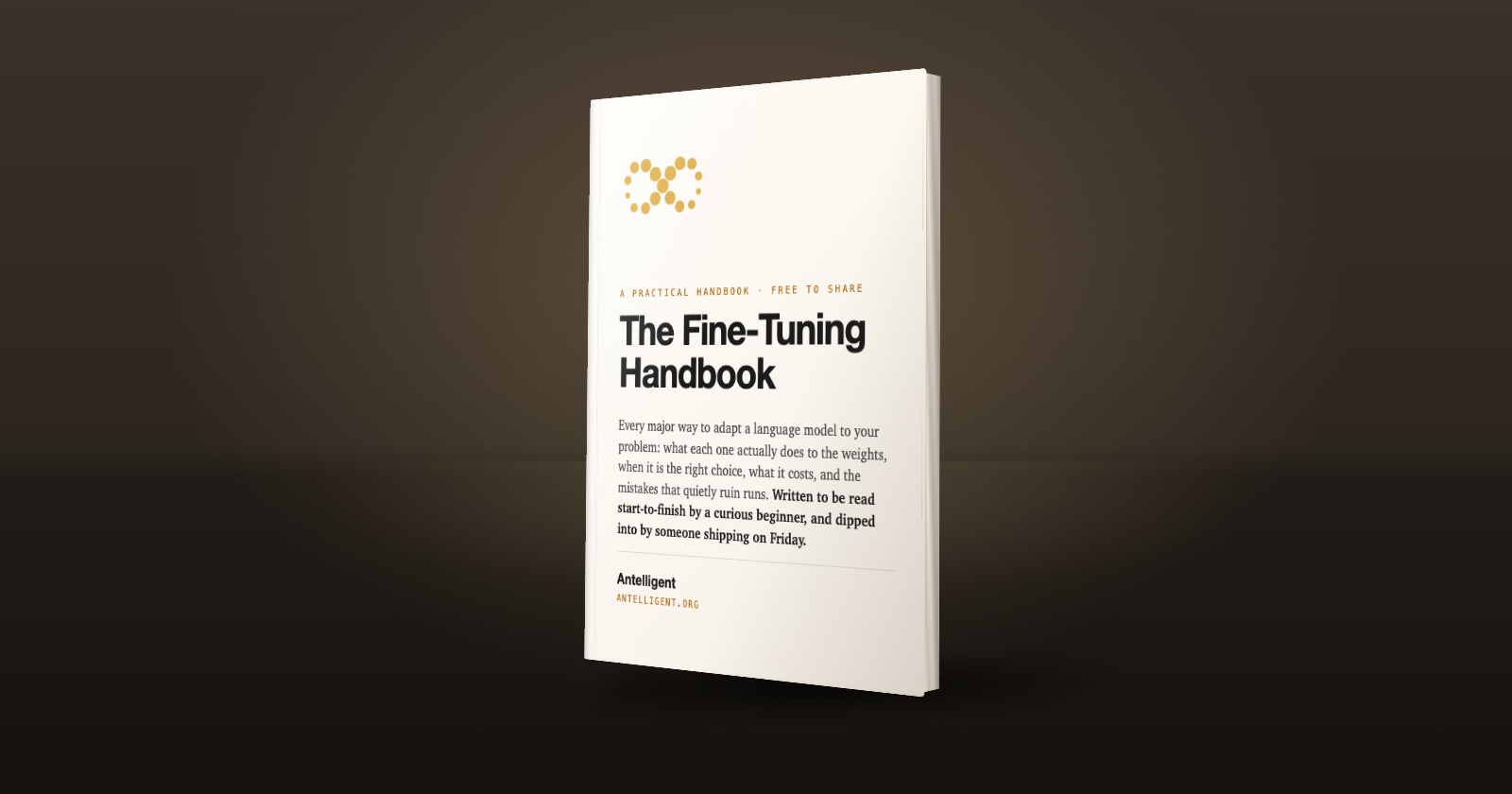
We have published The Fine-Tuning Handbook, a 61-page guide to adapting a language model to a specific task. It covers when fine-tuning is the right choice, which method to use, how to prepare training data, and how to evaluate the model you end up with.
We first shared it with the attendees of our August webinar, AI Token Cost Reduction: Tips and Tricks, as promised before the event. Now it is available to everyone.
It is free. Visit fernfly.com/ebook, enter your email and the code FERNFLYBLOG, and we will email you the PDF and EPUB.
Who it is for
The handbook is for developers and teams who are considering fine-tuning, or who have started and want a clearer picture. It assumes you know what a neural network is, but not that you have trained one.
When to fine-tune
The opening chapter asks whether you need to fine-tune at all. Often you don't. It suggests trying four approaches in order and stopping at the first one that works:
- Prompting. Rewrite the instructions and add examples.
- Retrieval and tools. Give the model the information it lacks.
- LoRA. Train a small set of new weights when the model has the information but responds in the wrong format or style.
- Full fine-tuning. Retrain all the weights, for a new domain or language with a very large dataset.
Each step takes more time and money than the one before and is harder to undo.
Behaviour, not knowledge
One idea runs through the book: fine-tuning teaches a model how to respond much better than it teaches facts. Output format, tone, and which tool to call with which arguments repeat across every example, so a model learns them from a few hundred to a few thousand samples. A single fact, such as which plan a customer is on, appears only a few times and is learned poorly.
That makes retrieval the better way to add product knowledge. In one study the book cites, retrieval raised a model's score on a current-events task from 0.481 to 0.875. Fine-tuning raised it to 0.504.
Fernfly follows the same principle. A Fern model learns which function to call and how to fill in its arguments, and your API supplies the data.
Contents
- What fine-tuning does. What changes inside the model, and what does not.
- Methods. Full fine-tuning, LoRA and its variants, adapters, and model merging.
- Teaching behaviour. Supervised fine-tuning, RLHF, DPO, GRPO and distillation, and when to use each.
- Engineering. Dataset size, memory requirements, hyperparameters, and a starting configuration.
- Evaluation. Building a test set, using public benchmarks, and using an LLM as a judge.
- Pitfalls. Catastrophic forgetting, chat template mismatches, loss masking errors, and overfitting.
- Recipes. Six worked setups, including structured output, tool calling, and distilling a large model into a small one.
- Reference. A checklist to run before training, a glossary, and open questions.
How it was written
We wrote the outline, chose the examples, and checked the claims against primary sources and our own training runs. The text was drafted with AI assistance.
Get your copy
- Open fernfly.com/ebook.
- Enter your email and the code
FERNFLYBLOG. - Download the PDF or EPUB from the links we email you. They stay valid for 30 days.
The handbook is free to share.

Anurag (aka `AnuRock`) leads tech and engineering at Fernfly, where he builds the platform that turns natural language into reliable tool calls. He aspires to be the dark lord of AI agents of the world one day.
LinkedIn