Intent→Action vs Chat: Two Different Jobs
Comparing Fern to ChatGPT compares two jobs, not two sizes. Chat rewards scale. Intent→action rewards specialization.
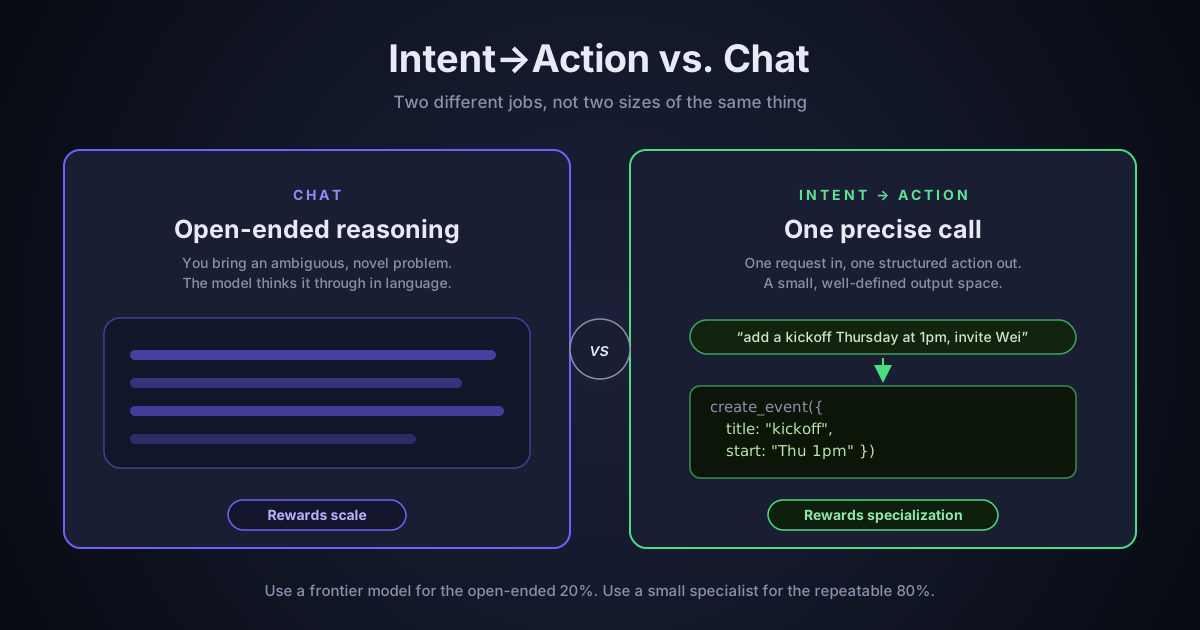
When people size up a model like Fern against ChatGPT or Claude, they are comparing two different jobs, not two sizes of the same thing.
Two jobs, not two sizes
Chat is open-ended. You bring an ambiguous, novel, or reasoning-heavy problem, and the model works it out in language. Breadth and reasoning are the whole point. That is what a frontier model is for.
Intent→Action is the opposite shape. You take one natural-language request and turn it into one precise, structured action: an API call with the right name and the right arguments. The set of valid outputs is small and well defined. You do not want creativity here. You want the correct call, fast, every time.
These are not two points on one scale. They are different jobs, with different definitions of success.
Different success criteria reward different tools
Chat rewards scale. The harder and more open-ended the problem, the more a big general reasoner earns its keep.
Intent→Action rewards specialization. A small model tuned to a bounded set of tools hits the target as reliably as a giant one. And because it is small, it brings advantages the big model cannot:
- Speed. It answers in milliseconds, not a cloud round-trip.
- Cost. A fraction of a frontier call, which is the whole ballgame once you multiply by volume.
- Privacy. It runs on a CPU, offline, on your own hardware. The data never leaves.
- Control. You can constrain and ground its output, so it cannot wander off your schema.
On a bounded task, none of the frontier model's extra capability is doing work for you. You are renting a reasoner and using none of the reasoning.
One request, two jobs
Take a single line off a support queue:
"customer can't log in after a password reset"
Hand it to a chat model and you get the chat job: a paragraph of competent, empathetic prose. "It sounds like your customer is locked out after resetting their password. Here are a few things to check first..." Useful to a human. But your system does not need a paragraph. It needs to file the ticket. So now you write code to parse that prose back into fields, and you hope the next reply is shaped the same way. It usually is not.
Frame the same line as intent→action, and the job is one call:
route_ticket({ queue: "auth", priority: "high" })
That is the whole output. The right queue, the right priority, nothing to parse, nothing to clean up. A small model tuned to your ticket schema returns it in milliseconds, at a fraction of the cost, and it cannot route to a queue that does not exist, because the schema will not let it.
Same request. One version reasons in language and hands you text to interpret. The other commits to a structured action. The first is the chat job. The second is the intent→action job, and it is the one your pipeline actually needed.
The same shape holds wherever the work repeats. Take a line from an e-commerce inbox:
"the mug in order 4821 arrived cracked, I want a refund"
The chat job writes back a friendly reply. The intent→action job files the operation:
create_refund({ order_id: 4821, reason: "damaged" })
One request, one structured action, ready to hand straight to your refunds API. Nothing to interpret, and no way to refund an order that does not exist.
So is Fern better than ChatGPT?
The honest answer is that they are built for different jobs. Use a frontier model for the open-ended 20%. Use a small specialized model for the repeatable intent→action 80%.
Most production systems need both. The trouble is that most are using the chat tool for the action job, and paying for it, on every call, forever.
See the two jobs side by side
You do not have to take this on faith. In the Fernfly Playground, type an intent of your own, or pick a ready-made one, and watch a small specialized model and a frontier model turn it into the action side by side. The latency, the cost, and the correctness sit right there in the columns.

Anurag (aka `AnuRock`) leads tech and engineering at Fernfly, where he builds the platform that turns natural language into reliable tool calls. He aspires to be the dark lord of AI agents of the world one day.
LinkedIn